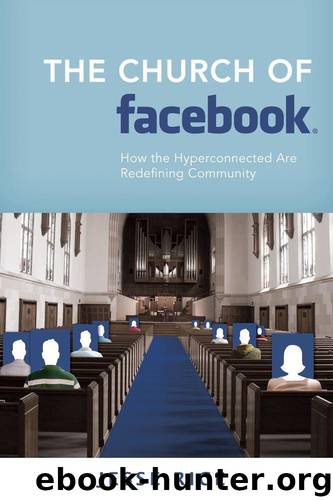
The Church of Facebook: How the Hyperconnected Are Redefining Community by Jesse Rice
Author:Jesse Rice [Rice, Jesse]
Language: eng
Format: epub
Publisher: David C Cook
Published: 2009-10-01T04:00:00+00:00
It’s hard to imagine a world before Facebook. Even though it’s only been around since 2004, it has become a staple of our social diet in both the real and virtual worlds. While there had been plenty of social networks prior to the meteoric rise of Facebook, none seemed to tap in to such a large and diverse population. This consolidating effect shifted the kind of access we had to one another’s personal worlds (pictures, personal histories, friends), making it easier than ever to experience a level of “knowing” about one another, even within a very large group of people.
In that sense, we “saw” things differently before Facebook. Our social worlds prior to Facebook were more clearly divided. For example, maybe we thought of our coworkers and classmates being over there and our closest friends and family over here. There may have been some blending of social connections, but for the most part we had more access to the personal lives of friends than we did to many of our coworkers, and that level of access is what defined the relationship.
But since the advent of Facebook, there’s a new way of seeing, one that is much broader in scope, a view that takes in hundreds of different relationships in one glance, all with significantly increased levels of self-revelation. Now it’s less likely that some of our relationships are here and others over there. Thanks to Facebook, they’re all right in front of us, available to us at any moment. But this way of seeing is so new, we’re still getting used to it in many ways. Like Virgil, our “eyes” are still adjusting to the view.
Sacks writes, “When Virgil opened his eyes, after being blind for forty-five years, there were no visual memories to support a perception; there was no world of experience and meaning awaiting him. He saw, but what he saw had no coherence.”
Virgil’s experience was virtually identical to the two dozen or so cases like his that have been reported throughout history. The “seeing” world, it turns out, is one of overwhelming chaos to a formerly blind person. This was certainly true for Virgil. He could not focus his eyes. He could not judge distances. Walking proved terrifying and objects seemed to jump out at him. He would get confused by his own shadow. “Virgil’s sight might be largely restored,” observed Sacks, “but using his eyes, looking, it was clear, was far from natural to him; he still had many of the habits, the behaviors of a blind man.”
Like Virgil, when we move from an old way of seeing to a new way of seeing, things are blurry at first. It might even be frightening. And one of the new and unpredictable outcomes of the spontaneous order found in Facebook is the blurring of our social world. In many ways our eyes are still adjusting to the reality of Facebook. We’re just beginning to learn how to navigate the new relational opportunities and styles found in a hyperconnected context.
Download
This site does not store any files on its server. We only index and link to content provided by other sites. Please contact the content providers to delete copyright contents if any and email us, we'll remove relevant links or contents immediately.
The 5 Love Languages: The Secret to Love That Lasts by Gary Chapman(9792)
The Space Between by Michelle L. Teichman(6932)
Assassin’s Fate by Robin Hobb(6200)
Wiseguy by Nicholas Pileggi(5771)
Everything Happens for a Reason by Kate Bowler(4734)
Gerald's Game by Stephen King(4642)
Pillow Thoughts by Courtney Peppernell(4273)
A Simplified Life by Emily Ley(4158)
The Power of Positive Thinking by Norman Vincent Peale(4062)
Harry Potter and the Prisoner of Azkaban (Book 3) by J. K. Rowling(3355)
Resisting Happiness by Matthew Kelly(3337)
Girl, Wash Your Face by Rachel Hollis(3282)
Being Aware of Being Aware by Rupert Spira(3272)
The Secret Power of Speaking God's Word by Joyce Meyer(3184)
The Code Book by Simon Singh(3181)
More Language of Letting Go: 366 New Daily Meditations by Melody Beattie(3024)
Real Sex by Lauren F. Winner(3016)
Name Book, The: Over 10,000 Names--Their Meanings, Origins, and Spiritual Significance by Astoria Dorothy(2983)
The Holy Spirit by Billy Graham(2944)
